
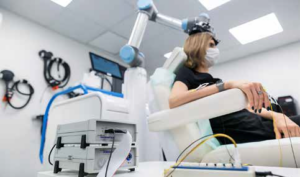
The Institute for Cognitive Neuroscience of HSE University in Moscow presents the TMS-Cobot among the equipment of its laboratory cluster, in its institutional brochure. The robotic system automatically controls the positioning and orientation of compatible TMS coils, under the control of an optical navigation tracking system. It is used for brain-navigated TMS, which can be…
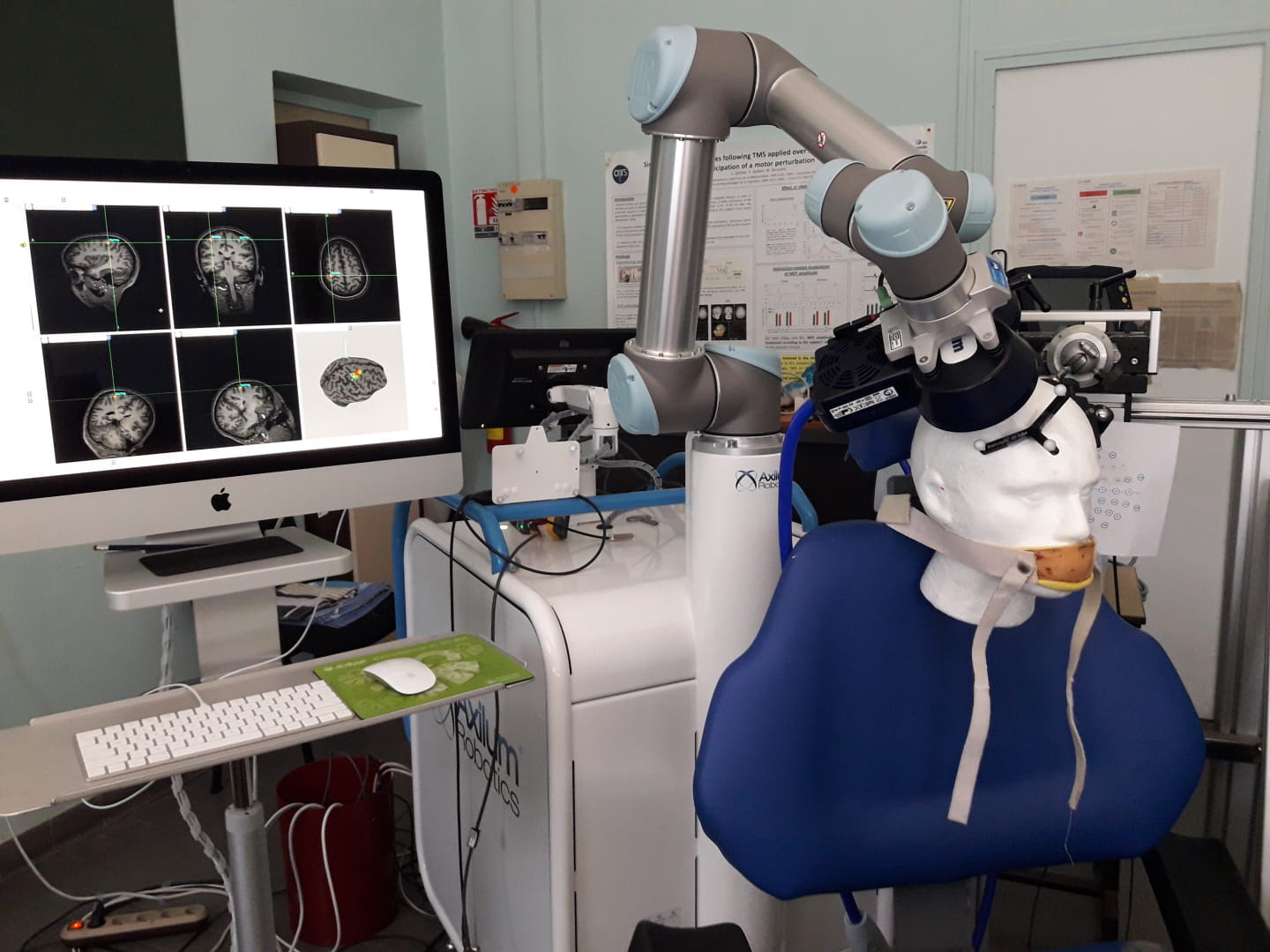
The NeuroMarseille institute (Aix-Marseille University) presents, among its technological platforms, a robotized and neuronavigated (MRI-guided) TMS system combined with simultaneous EEG recording, under the scientific management of Mireille Bonnard (CNRS) and Olivier David (INSERM). Used with healthy participants, it creates a brief, precisely targeted disturbance of brain activity, for example during cognitive tasks or at…
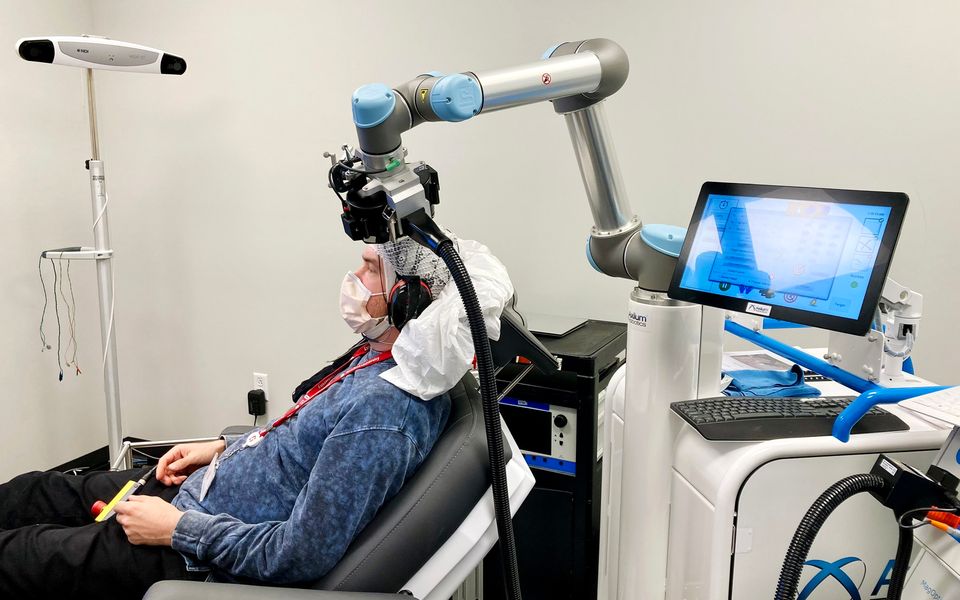
In a press release dated June 24, 2024, the University of Helsinki presents two studies, carried out with researchers from Stanford University, that aim to make magnetic stimulation (TMS) treatment for depression more personalized. The team recorded the brain’s electrical responses by EEG during stimulation, with a robot holding the TMS coil, to understand which…

Attending the Focused Ultrasound Neuromodulation conference in July 2024? Join us in Toronto where our team will be hosting demonstrations of robot-assisted positioning of an ultrasound transducer, with our partner IGT.
In April 2022, the CENIR neuroimaging platform of the Paris Brain Institute (Institut du Cerveau) acquired Axilum Robotics TMS-Cobot, then one of 40 systems installed worldwide and 3 in the Paris region. The institute already uses TMS in research on stroke, Tourette syndrome, abnormal movements such as dystonia, and autism. The robot is set to…

Visit the Localite booth to see demonstrations with TMS-Cobot.
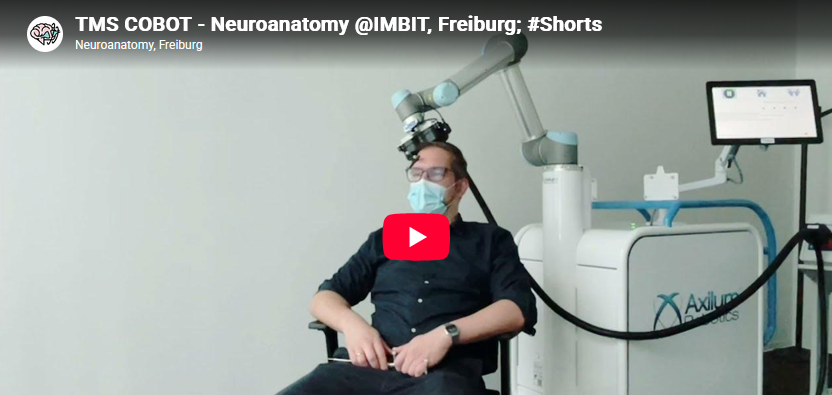
The Department of Neuroanatomy at the University of Freiburg has opened a new rTMS robot lab at the Intelligent Machine-Brain Interfacing Technology (IMBIT) centre. The team will investigate the neuronal mechanisms and plasticity-inducing effects of repetitive transcranial magnetic stimulation, together with collaborators in neurosurgery, optophysiology, bioelectronic microtechnology, neurorobotics and neuromedical AI. Stimulation is delivered using…

Visit the MagVenture booth to see demonstrations with TMS-Cobot.

Robotics contribution is highlighted in new Expert Guidelines for safety and recommendation for TMS use : Reliability, accuracy, repeatability of coil positioning, coil contact, reduced human interactions in the current pandemic context, reduced human bias, reduced exposure to electromagnetic fields. Importance to meet electrical safety and electromagnetic compatibility standards. Reference: Safety and recommendations for TMS…

Users speak the best of robotic image-guided transcranial magnetic stimulation! A video report has been recorded in Paris for French “Quotidien du Médecin” magazine, online issue of October 2019.