
At Singapore’s National University Hospital (NUH), clinicians are exploring personalised TMS to treat depression, anxiety and severe OCD. Each patient’s brain circuits are first mapped with fMRI, then a neuro-navigated robotic arm delivers magnetic pulses to the individual’s own stimulation target, in theta-burst sessions of about nine minutes instead of the conventional 37.5. In an early study on severe, treatment-resistant OCD, both patients who completed the five-day course of 40 sessions showed a substantial reduction in symptoms, and a larger study in depression with co-occurring anxiety is starting in October 2026. NUH’s Adj. Assoc. Prof. Tor Phern Chern highlights the promise of reaching deep-brain circuits “without surgery and in a single week of treatment”.
Read the full article and the NUH Press Release.
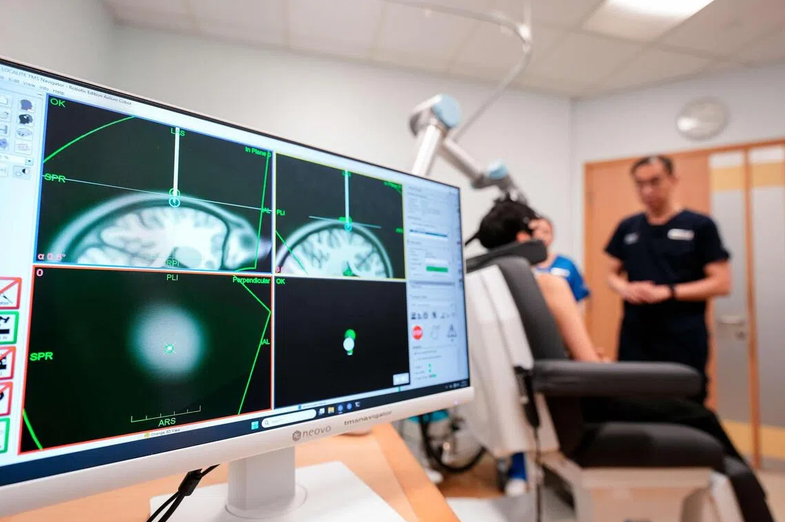
TMS treatment using Axilum Robotics TMS-Cobot at Singapore’s National University Hospital (NUH)